Howdy, I'm MSc. Matthew Kurantowicz
Courses Taken
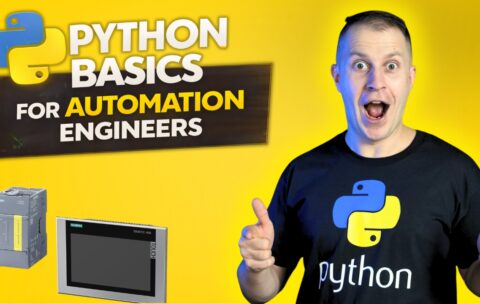
-75%
Beginner
Python Programming Basics for Automation Engineers
The “Python Programming Basics for Automation Engineers” course is a …
99,00 €400,00 €
Python Programming Basics for Automation Engineers
What you'll learn
Python programming from scratch – no prior experience required
Formatting process data using f-strings
Working with TXT and CSV files containing industrial data
Error and exception handling – creating reliable scripts
Console interface with ANSI colors – clear menus and messages for operators
Industrial data visualization in a web browser
Creating your own reusable functions and modules
Simulating data retrieval and processing from PLC registers
Real-world case of retrieving data from industrial devices with Python
Final project: complete Factory Data Analyzer – logging, data simulation, CSV and HTML reports
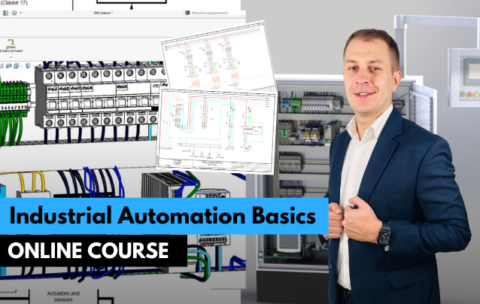
-33%
Beginner
Industrial Automation Basics and Electrical Diagrams
This Industrial Automation Basics course is designed for individuals looking …
189,00 €280,00 €
Industrial Automation Basics and Electrical Diagrams
What you'll learn
Learn how to read electrical diagrams for industrial automation systems.
Understand the fundamentals of industrial automation and its key components through an introductory overview.
Learn how to join and utilize a professional support community, such as the Discord group for automation professionals and PLC programmers.
Receive and use the Automation Design Guide, a comprehensive resource to assist in project planning and execution.
Understand the design principles and assumptions for industrial machines, such as a pallet wrapper system.
Familiarize yourself with the standards (IEC 60204-1) and directives for machine design, ensuring compliance with industrial regulations.
Explore the functionality and operation of electric motors, including their role in automation systems.
Learn about machine supply systems, understanding how to design and configure effective power delivery solutions.
Discover the selection criteria for enclosures and measurements in LV switchboards, in compliance with IEC 61439 standards.
Understand the components and devices in a control cabinet, from relays to circuit breakers.
Learn the principles of power supply design for PLCs and control circuits, ensuring stability and efficiency.
Gain knowledge about overcurrent protection for 24VDC circuits, safeguarding systems from electrical faults.
Understand how to integrate PLC controllers into electrical diagrams, bridging the gap between hardware and software.
Explore digital and analog I/O systems, including inputs, outputs, and their connection to automation devices, as well as connecting inverters and servo drives for motion control.
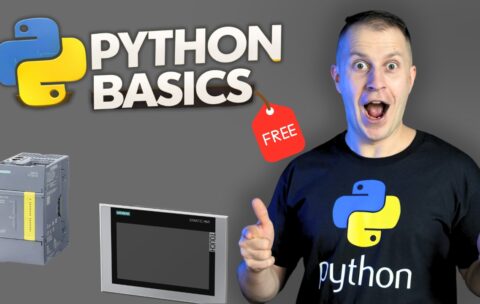
Free
Beginner
Python for Automation Engineers Mini-Course
Want to learn Python and apply it in industrial automation? …
Free
Python for Automation Engineers Mini-Course
What you'll learn
Why Python is an essential tool for every modern automation engineer
Python syntax basics: variables, loops, functions, dicts and file handling
How to communicate with a PLC over Modbus TCP using the pymodbus library
How to read tags from a Siemens S7-1500 via OPC UA with the asyncua library
How to write your own monitoring and process data logging scripts
-75%
Beginner
Basic PLC Structured Text Programming Course in CODESYS
This comprehensive online course is designed to introduce participants to …
99,00 €400,00 €
Basic PLC Structured Text Programming Course in CODESYS
What you'll learn
Master the ST programming language in the CODESYS environment, essential for advanced PLC programming.
Learn how to code in CODESYS IDE, gaining hands-on experience with this powerful tool.
Understand variable declarations, integer, floating-point and string operations, key to developing robust PLC programs.
Master advanced program flow control instructions, including IF... THEN, CASE, loops such as FOR, WHILE, and REPEAT, to create efficient and complex applications.
Learn programming in a virtual environment using Factory IO, simulating real-world industrial processes.
Dive into software organizational units such as POU, FB, FC, Actions, and more, essential for structuring and organizing automation projects.
Focus on key automation topics, including operators, edge detection, timing instructions, and counters, learning step by step to build advanced automation systems.
Develop practical skills through project-based exercises, allowing you to apply what you’ve learned in real-world scenarios.
Receive live support through Discord and interactive meetings, ensuring all your questions are answered as you progress.
Earn a certificate in both Polish and English, validating your skills and boosting your career opportunities in automation and PLC programming.
-75%

